
Zaječar · Timočka krajina · 2026
Why did Timočka Buna rise?
- Because a mine and a smelter are planned less than 10 km from downtown Zaječar.
- Because we know what Bor and the villages around Čukaru Peki breathe and drink.
- Because the ore is sulphide, and acid drainage lasts for centuries.
- Because this company builds first and asks for permits later.
Source: early public review document for the spatial plan · Institute of Architecture and Urban & Spatial Planning of Serbia, July 2026 · client Serbia Zijin Mining. Distances are our own measurement.
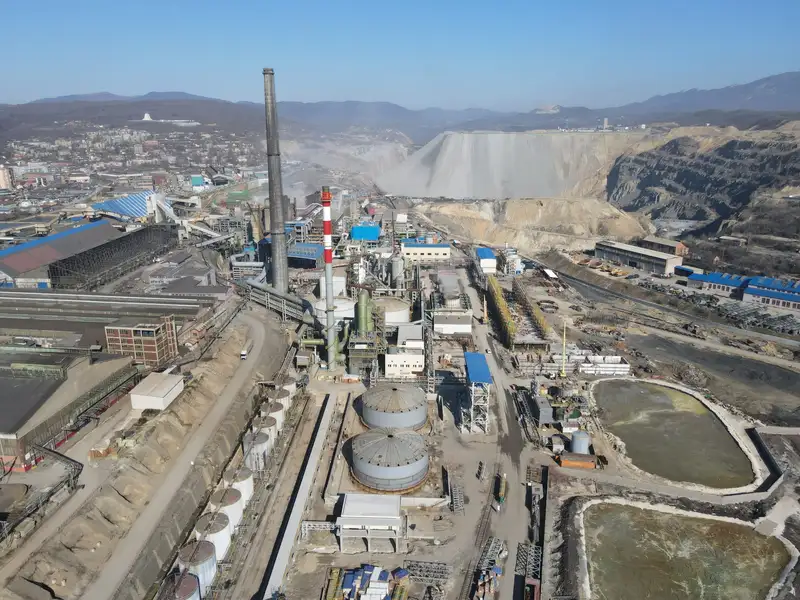
↑ Bor · smelter
Two mines, a smelter and a tailings dam in one plan covering 126 km².
The earlier decision covered only the lower zone of Čukaru Peki. The new decision erases that boundary and pulls the entire complex into a single expansion plan: the still-unopened Malka Golaja deposit, a brand-new smelter (up to 850,000 t of copper a year) and a 1,900 ha tailings dam.
Čukaru Peki
An already active copper and gold mine, wholly owned by Zijin. The plan provides for mining the lower zone by caving, down to 1,300 and later 1,800 metres, and two new flotation plants of 14.85 million tonnes of ore a year each, against today's 3.3 million. According to Zijin's 2025 annual report, the upper zone has 15 years left and the lower zone is planned for 66. The plan itself says the upper deposit will be finished “within the next ten years”.
Malka Golaja
A new copper and gold deposit whose discovery was announced in March 2025, just 7 km southeast of Čukaru Peki, on Zaječar's territory (cadastral municipality Zvezdan), between Metovnica and Nikoličevo. The upper ore body is massive sulphide, and the plan also provides a pyrite-concentrate depot (material that generates acid mine drainage) in the Veliki Timok basin. Among the site's advantages the plan lists: “relative distance from settlements”.
New smelter
A brand-new smelter on a site “outside existing mining and industrial zones”, provisionally in the cadastral municipality of Metovnica. Capacity is up to 400,000 t of anode and cathode copper a year, “with reserved capacity for a further 450,000 t/yr”. It would process concentrates from the Lower Zone, Malka Golaja and the Bor mines, plus pyrite concentrate from the Čukaru Peki depot. Sulphuric acid would be piped to the railway at Zagrađe. The plan requires a Seveso impact zone of at least 1,000 metres, and says of arsenic removal that it “must be carried out under extreme control”. Work on the smelter's studies has “only recently begun”.
New tailings dam
A flotation tailings facility in the Kriveljska river valley near Oštrelj, downstream of the existing “Veliki Krivelj” tailings. Over the life of the mine it would receive about 1.08 billion tonnes of tailings. The plan calls this a “relatively small occupation of space”. On our estimate, that volume is roughly equal to all existing tailings facilities in Serbia combined: 754 million m³ in 31 facilities, according to the International Commission for the Protection of the Danube River (ICPDR).
Who is behind the project
Funding for the strategic assessment is provided by Serbia Zijin Mining, a foreign company that also takes all the profit.
The plan covers the cadastral municipalities:
Inside the zone of direct mining impact, under the plan, “no new buildings may be constructed, only the function of existing ones maintained until resettlement”. How many households that covers, the plan does not say.Elaborat, PDF p. 17
The pollution frontier is moving south.
Malka Golaja is just 7 km southeast of Čukaru Peki, which means mining is closing in to less than 10 kmfrom the first houses of Zaječar.
This map is illustrative. See the full map here.
Pollution does not respect municipal boundaries. Whatever leaves the tailings, the flotation plant and the smelter is carried by wind and water.
The figures were published by the company
All data below comes from the official Request for the strategic assessment, the very document that launches the expansion. The figures are from 2023 and 2024, from measuring stations around Bor and Čukaru Peki.
Air
Source: Request, pp. 29–32times arsenic exceeded the limit and tolerance values during 2024.
Soil
Source: Request, pp. 21–22of samples had copper and vanadium above maximum allowed concentrations.
Surface waters
Source: Request, pp. 23–24parameters failed Class II water quality standards (2024).
Groundwater
Source: Request, pp. 25–26heavy metals above drinking-water limits: copper, arsenic, nickel, cadmium, plus organic matter.
MAC = maximum allowed concentration. Values above remediation thresholds trigger a legal obligation to clean up the soil under Serbian regulations. This is the state of things before the planned capacity expansion.
The measurements in the Request were commissioned by the company itself; air was sampled at 16 points, including the yards of named households. In Bor, Serbia's Environmental Protection Agency recorded a 2024 annual mean arsenic concentration of 42 ng/m³ (Jugopetrol) and 24 ng/m³ (City Park), against a target value of 6: seven and four times higher. The highest daily lead concentration was 2,898 ng/m³, nearly three times the daily limit.
Behind every number is an organ that fails.
The evidence shows which toxins are crossing the limits. Here is what exactly they do to the human body, and who is most at risk. Every claim comes from the World Health Organization (WHO), IARC and ATSDR.
Arsenic
Air · 61× above the limit (2024)IARC Group 1 · proven carcinogenLong-term inhalation and ingestion of arsenic causes cancer of the lungs, bladder and skin, and is also linked to kidney and liver cancer. Before cancer, the skin develops thickening on the palms and soles and changes in pigmentation. Chronic exposure raises the risk of heart disease and diabetes.
MOST AT RISKIt hits children and unborn babies hardest: exposure in pregnancy and early childhood disrupts brain development, memory and intelligence.
Cadmium
Air · 44× above the target value (2024)IARC Group 1 · proven carcinogenCadmium settles in the kidneys and stays for decades: over the years it damages the kidneys and breaks down bone, leading to osteoporosis and fractures. Inhalation causes lung cancer, and it is also linked to kidney and prostate cancer.
MOST AT RISKMost at risk are the elderly and post-menopausal women (brittle bones), as well as smokers, whose exposure adds up.
Lead
Air · 1.068 µg/m³, above the annual limit (2024)IARC Group 2A · probable carcinogenThere is no safe dose of lead. In children it permanently damages brain development, lowering intelligence (IQ), shortening attention span and changing behaviour, and that damage is irreversible. In adults it raises blood pressure and damages the heart and kidneys.
MOST AT RISKChildren absorb 4–5 times more lead than adults. In pregnancy, lead passes from the mother's bones to the baby, causing miscarriage, premature birth and low birth weight.
PM10 particles
Air · 26× above the limit (2024)IARC Group 1 · air pollution causes lung cancerFine particles penetrate deep into the lungs and enter the bloodstream. In the short term they worsen asthma and chronic obstructive pulmonary disease (COPD) and fill hospital wards; in the long term they cause lung cancer, heart attacks and strokes, and shorten life expectancy.
MOST AT RISKThey hit hardest children, the elderly and everyone with heart or lung disease and asthma.
Metals in water and soil
Drinking water · 5 metals above the limit; copper in every soil sampleNickel · IARC Group 1Nickel, mercury, copper, zinc and other metals were measured above permitted levels in groundwater, surface waters and soil. Nickel (a proven carcinogen, Group 1) causes lung and nasal cancer. Mercury accumulates in the body and permanently damages the nervous system and kidneys. Excess copper in drinking water damages the liver and causes digestive problems.
MOST AT RISKPregnant women and small children are most at risk: mercury disrupts fetal brain development, and metals in drinking water attack the kidneys and liver.
What Zaječar fears has already been measured in Bor. A 2020 study by Serbia's Institute of Public Health “Batut” (supported by UN Environment and the WHO) found a significantly higher risk of developing and dying from cancer, for all malignant tumours except skin cancers, in both men and women, including a significantly higher risk of lung cancer. Source ↗
The rock that turns to acid when it meets the air.
Every deposit in this plan is sulphide ore. The company has already tested what that means at a mine it runs. The result is in one of its documents, and missing from another.
Underground, it is safe
In the ore, copper is locked up with sulphur, as pyrite and chalcopyrite. Sealed in the ground, nothing happens.
Dug up and crushed, it reacts
In contact with air and rain the sulphur turns into sulphuric acid. Bacteria speed the reaction up many times over.
The acid dissolves metals
Copper, zinc, cadmium, nickel, lead and arsenic pass from the rock into the water.
And then it feeds itself
The reaction keeps going after the mine closes. Roman-era mines in Spain still leak acid water today.
Why it is so dangerous
It does not stop when the mine closes
Acid drainage goes on for decades and centuries after the last tonne of ore. That makes it the longest and most expensive liability in mining.
It travels with water
Acid water carrying dissolved metals does not stay on the dump. It enters groundwater and streams, and from here the Timok and the Danube.
It cannot be switched off
Once started, it cannot be repaired. It can only be prevented in advance, by design, or the water treated for as long as it keeps flowing.
Proof from their own paperwork: Majdanpek
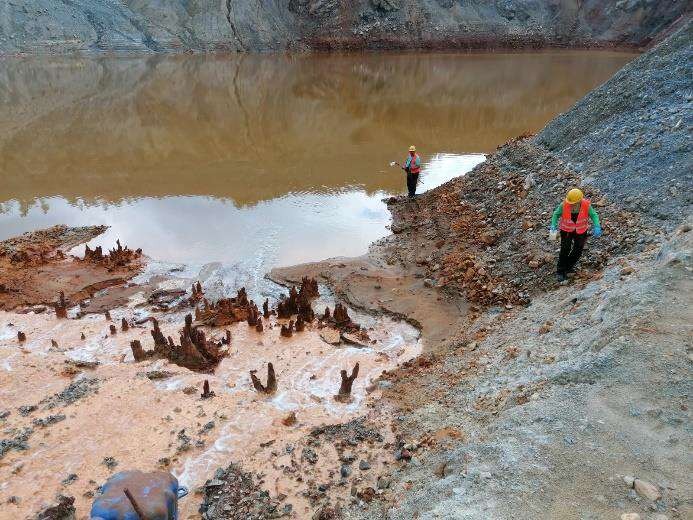
Sources: Mining Waste Management Plan, Majdanpek Open Pit (Mining and Metallurgy Institute Bor, 2025), sections 8.2–8.7 and Annex 5; received by the company on 9 March 2026 and published by the Ministry of Mining and Energy on 4 June 2026. · Environmental Impact Study, waste disposal from the Severni revir pit (ITNMS, 14 April 2026; PDF in Serbian, 35 MB), Table 6.3. Both documents were commissioned by the company.
And Malka Golaja?
- The upper ore body at Malka Golaja is massive copper-gold sulphide, and the mine complex includes a “pyrite concentrate depot”.Elaborat, PDF pp. 22–23
- The plan itself speaks of dumps of “acid” mining waste, to be lined with a geomembrane as “permanent protection”, and says mine waters “may have elevated acidity during the operation of the mine and after its closure”.Elaborat, PDF pp. 12 and 32
- No test of this waste's potential to generate acid drainage has been published: not for Malka Golaja, not for the pyrite concentrate, not for the Lower Zone tailings. Work on the studies has “only recently begun”, and the plan went to public consultation anyway.Elaborat, PDF p. 5
- This is not a distant risk. The Borska river is already “out of class” today, and Bor's wastewaters carry about 400 tonnes of copper a year towards the Danube, at pH 2.6.Elaborat, PDF p. 8 · Đorđievski et al. (Mining and Metallurgy Institute Bor), Environmental Science and Pollution Research, 2018
Early public review document, “Elaborat” (PDF in Serbian, 23 MB) · page numbers are PDF pages
If it was all legal, why did they pull out the machines?
At the end of May we found a column of haul trucks and freshly cut roads at Malka Golaja, without a word to the people living nearby. By mid-August there was nothing there, and there was still nothing on 22 September. The company has not said why to this day.
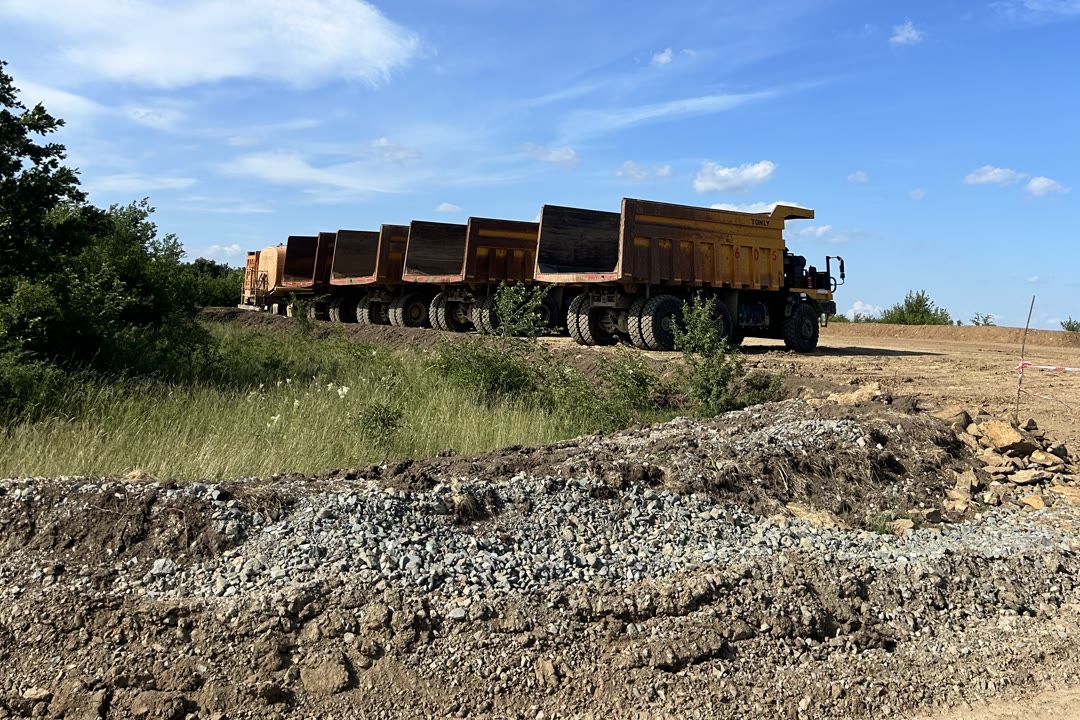
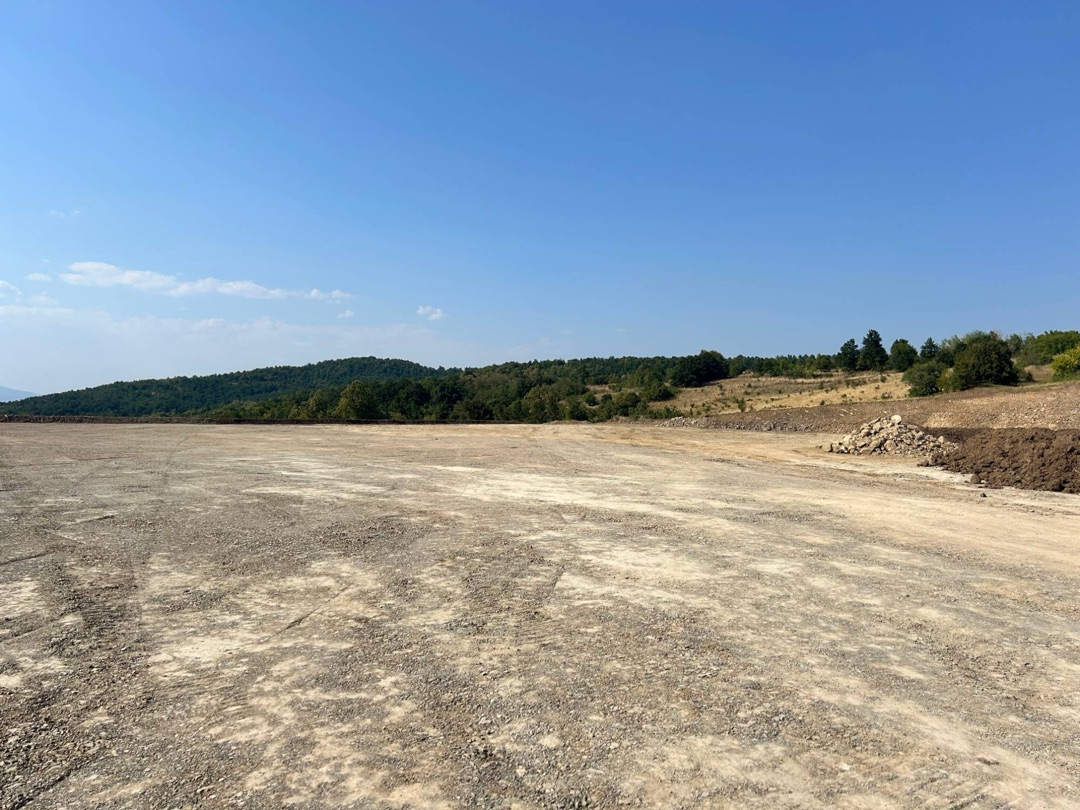
We find a column of haul trucks
According to the site board, the works were notified on 15 April and began on 20 April, on 29 cadastral parcels in Zvezdan. Nobody in the surrounding villages was told.
11 June 2026Inspectorate: 11.49 hectares of forest cleared unlawfully
The republic forestry inspectorate finds clearing without consent, in breach of Article 9 of the Law on Forests: all the timber “pushed and buried by construction machinery”. It orders a halt, effective “immediately”.
The company's appeal is rejected
A commercial-offence complaint against the company and its responsible officers goes to the Zaječar prosecutor. Source: Glas Zaječara.
Zaječar councillors file a criminal complaint
They claim the works go beyond the permits the company holds.
14 August 2026Nothing is left on site
No machinery, cabins, equipment or signs. The company has not said why.
An approval for geological exploration exists and runs to 2028. There is no approval for mining. There was no consent for clearing the forest: the republic inspectorate established that, not us. Why the machines were withdrawn we do not know, and we will not pretend to. So we ask.
Not the first time
A penalty below the statutory minimum
The Commercial Appellate Court finds that the lower court set the penalty far below the statutory minimum, for sulphur dioxide emissions 8.3 times the legal limit.CINS, 16 November 2021.
Building without approval, operating without the integrated permit
The Commercial Court in Zaječar imposes fines of RSD 200,000 and 250,000.RERI; court records, October 2022.
A court annuls the flotation expansion permit
Administrative Court: no environmental impact assessment had been carried out at all.RERI; BIRN, July 2023.
Seventh conviction for illegal construction
This time for a mining structure on the RTH tailings dam. At the end of the year the company is one of Serbia's two largest operators still without the integrated (IPPC) permit at the legal deadline.Nova ekonomija, 13 September 2024; Balkan Green Energy News; RERI.
Veliki Krivelj operating without mining permits
Mining inspectors find this on 30 January. An indictment by the Zaječar prosecutor follows in June.Ministry of Mining and Energy inspection record; Basic Public Prosecutor's Office, Zaječar.
Malka Golaja
Inspectors halt works at the site of the new mine, before the plan meant to allow it has even reached public consultation.Republic forestry and hunting inspectorate, 11–12 June 2026.
What Zijin says, and what the record shows
ZIJIN SAYS“We will seek regulatory approval at every stage of a project, to ensure that endangered species and fragile ecosystems are not damaged.”zijinmining.com · Ecological Conservation
ON THE RECORDAt Malka Golaja 11.49 hectares of forest were cleared without consent, before the first public consultation on the plan that is supposed to allow the mine. At Majdanpek, according to a request for an extraordinary inspection filed by two associations on 10 August 2026, the company's representative confirmed at the public hearing that trucks are already working on the waste-dump parcels and that there are no permits for those works.
ZIJIN SAYS“All of our flood control projects are designed and constructed with the capacity to withstand once-in-a-century or more severe disasters.”zijinmining.com · Water
ON THE RECORDIn the mining waste management plan for the Majdanpek open pit, the drainage channels of the waste dumps are sized for fifty-year rainfall. The same document records that in May 2014 rain flooded the lower benches of the Severni revir pit and people and equipment were evacuated.
ZIJIN SAYS“We incorporate ARD into our overall water cycle system … neutralizing it … After ensuring it meets the required standards, we either reuse or discharge the treated water.”zijinmining.com · Water
ON THE RECORDThe mining waste management plan classifies all six Majdanpek dumps as generating acid drainage, and its measures chapter contains not one measure against it: no cover, no liner, no separation of material, no treatment plant.
ZIJIN SAYSTarget: “100% restoration of all restorable land.”zijinmining.com · Ecological Conservation · Targets and Performance
ON THE RECORDAccording to the Ministry of Mining and Energy's draft strategic assessment of 30 April 2025, as reported by Forbes Srbija and N1, in 2023 Zijin rehabilitated 49.19 hectares in Serbia and newly degraded 127.96.
ZIJIN SAYSTarget: “No major human rights violations.”zijinmining.com · Human Rights · Targets and Progress
ON THE RECORDOn 16 June 2026 U.S. Customs and Border Protection barred the products of Serbia Zijin Copper over forced labour, citing six of the eleven International Labour Organization indicators. That is a finding by a customs authority, not a court judgment. Our report →
The statements were retrieved from zijinmining.com on 12 September 2026 and checked again on 21 September 2026; the link under each leads to the page where it appears. They are group-wide commitments: none names a facility in Serbia, although Serbia supplied 27% of the group's mined copper in the first half of 2026.
Why nobody stops them
Two mining inspectors for 833 sites
That is how many there were in 2024 for the whole of Serbia, according to a Ministry of Mining and Energy reply (three on another count). There are 56 environmental inspectors, against 86 established posts.Nova ekonomija, 29 February 2024; Forbes Srbija, 19 August 2024.
Seven convictions, about €68,000
That is the sum of all fines across seven convictions for illegal construction: under 0.05% of one year's profit. Five of the seven are below the statutory minimum. Serbia's Fiscal Council concluded back in 2018 that for some companies it pays better to pay the fines.Nova ekonomija, 13 September 2024; Fiscal Council, 26 June 2018.
Zijin pays for the state's plan
The cost of drafting the spatial plan, which will be the basis for expropriation, the smelter and the tailings dam, is borne by Serbia Zijin Mining, the company for whose benefit the plan is being adopted. Our report →
“We are not asking you to trust us. We are asking you to check.”
The documents →Zaječar is not a mining town. It is a town of water, land and factories.
The healing waters of two spas
The plan itself says the thermal-mineral springs around Bor and Zaječar are probably connected. The hydrogeologists we asked say Zaječar's artesian waters are not at risk, but that a negative impact of mining on the waters of the Nikoličevo and Gamzigrad spas is possible, and that no groundwater model exists.
Fertile fields and livestock
Zaječar is a town of farming and livestock, not a mine. Heavy metals in the soil are irreversible.
The air our children breathe
The smelter processes highly toxic concentrate. Arsenic and cadmium do not stop at the municipal boundary.
Factories, not tailings
A dynamic small economy and mid-sized factories: that is the history of Timočka krajina, not a mining colony.
“To a mining company, groundwater is a nuisance. To us it is medicine, and a precondition for life.”
Latest from the campaign.
Bucharest wrote to Belgrade twice about Zijin, and ten months later there is still no answer
Romania's environment minister, Diana Buzoianu, asked Serbia's ministry on 13 November 2025 for transboundary consultations on Zijin's mines near Majdanpek and Bor. The request was repeated. No reply has come, the Romanian portal România curată reports.
18 August 2026After Romania, Bulgaria too: 12 organisations ask Sofia to enter the process over Zijin's complex
Twelve Bulgarian non-governmental organisations wrote to Bulgaria's Minister of Environment and Water on 18 August, a day after 28 Romanian organisations asked for the same. They want the status of a potentially affected party and the documents in Bulgarian.
17 August 2026Chinese gold, Romanian water: 28 NGOs urge Bucharest not to abandon the Danube
Twenty-eight Romanian non-governmental organisations have asked their environment minister to open transboundary public consultations on Zijin's “Čukaru Peki” and “Malka Golaja” complex. The letter invokes the Kyiv Protocol and asks that Romania be granted the status of a potentially affected party.
Nothing is final. Join the Buna.
Buna is the organised resistance of villages and town defending their water, land and health. Follow us, leave your email and tell us what you can do: every skill is needed.
Follow the official channels.
These are the only accounts and the only address Timočka Buna uses. Anything else speaking in our name is not ours.
We need help.
The Buna is run by people in their spare time. If you can do any of this, write to info@timockabuna.org and tell us what you can do and how much time you have.
Design
Graphic designers and illustrators: flyers, posters, social posts, infographics.
Writing
Writers, journalists and editors: news, statements and explainers anyone can follow.
On the ground
People in the villages and the town: handing out flyers, talking to neighbours, a dated and located photo when something happens.
Law
Lawyers: freedom-of-information requests, objections, complaints to inspectorates.
Expertise
Hydrogeologists, chemists, mining engineers, doctors, biologists: reading the studies, writing expert opinions.
Translation
Translators: English, Romanian, Bulgarian, Vlach.
Photo and video
Photographers, camera operators, drone pilots, editors.
Maps and data
GIS people and analysts: maps, processing measurements.
What comes next in the procedure
The early public review closed on 3 August 2026. Objections from citizens, associations and institutions have been filed, and the procedure continues.
- Drafting of the spatial plan and the strategic environmental assessment, which was not even produced in the early-review phase
- Public review of the draft, a new legal window in which objections are filed again
- Adoption of the plan: we will announce every new deadline as soon as it is known